
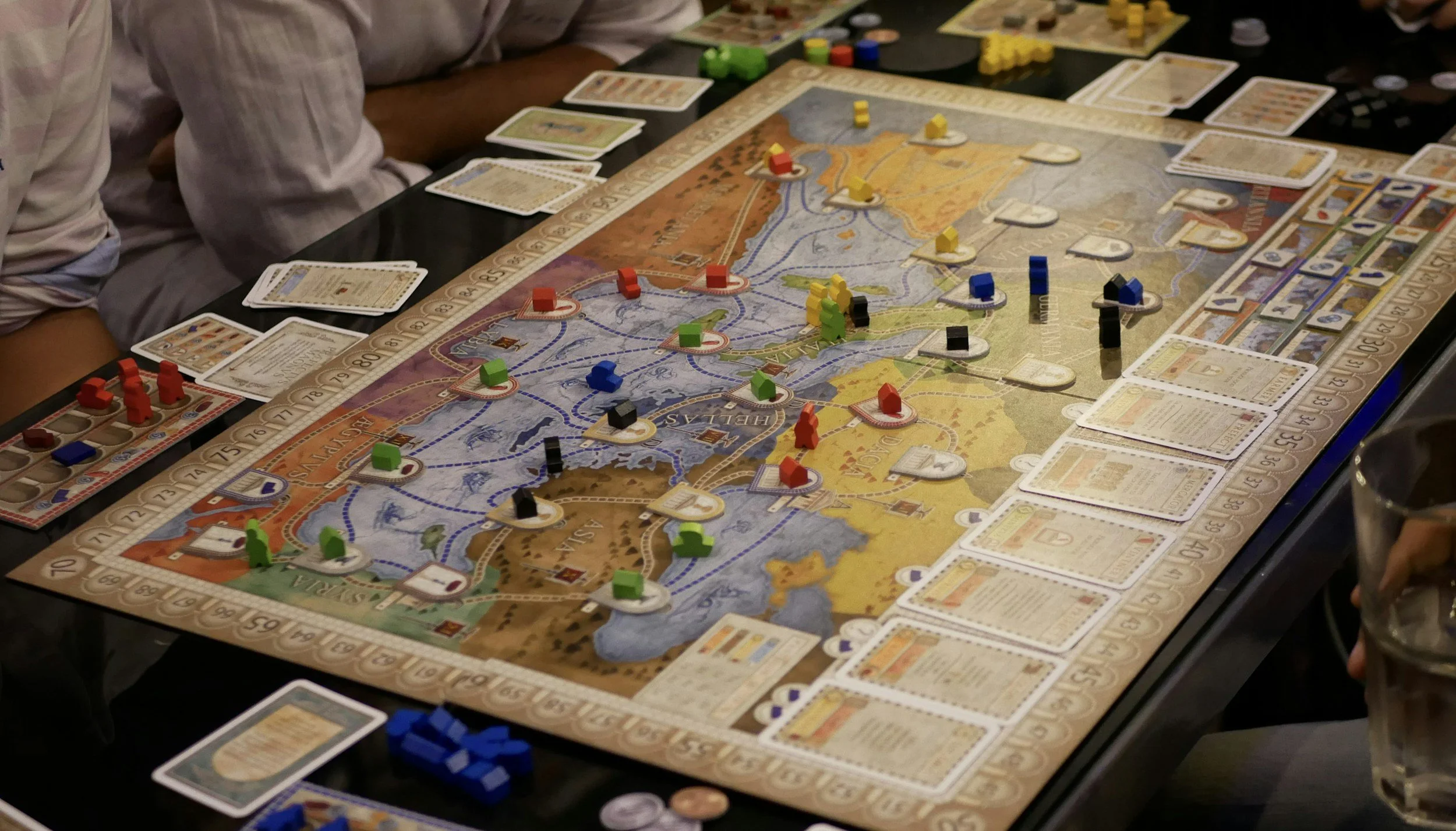
Boardgames
Emily Cole, University of Texas at Tyler
This guide is designed to help educators integrate game-based assignments into existing syllabi. It will cover the following: why board games are useful for students and scholars; what a board game is designed to teach; how to complete the assignment; what resources are available for students and educators to ensure a positive learning experience; and example prompts.
Why are board games useful for students and educators?
Board game assignments are a valuable tool for educators to meet diverse learning styles within the classroom. Designing board games requires students to gain content knowledge of a specific subject but challenges them to go beyond mere facts and utilize critical thinking. Developing game mechanics engages students’ lateral thinking, planning, and organizing skills, and prompts students to consider perspective, such as who the players are and how they interact within the game. The aesthetics of board game design provides an opportunity for artistic students to showcase their creativity. If assigned as group work, this assignment teaches collaboration, delegation, and conflict resolution. Finally, writing the game instructions builds students’ communication skills.
Goal of the assignment
Working in teams, students design a board game that brings to life a topic in Japanese studies. By designing the game in teams, students will:
Develop collaboration and teamwork skills by practicing communication, compromise, and accountability
Foster critical thinking by researching a chosen topic, asking probing questions of that topic, and using game design to bring the topic to life
Communicate their conclusions to an audience by translating complex ideas into accessible gameplay; and (4) Reflect on their learning by tracking how their knowledge of the subject evolves over the course of the term.
Click here for a full overview and example assignments including:
proposals, research portfolios, beta testing, and final submission.
How to make board games
The final product that students will submit is a board game. Educators can break down the assignment into scaffolded components: project proposal, research portfolio, beta testing and/or rough draft of game instructions, final submission, and research journals (see below for assignment component prompts). In addition to submitted components, educators can schedule dedicated “workshop” days for students to research, build components of the game in class, or test their games with other groups.
The following websites provide useful guides to board game construction:
Examples of history-based board games
The following list comprises examples of types of games students can create (turn-based, card-driven, strategy, etc.), each with a specific example of a board game title. Note that the list constitutes only a fraction of the many types of board game formats on the market!
Movement/Track Game | Players roll dice or spin a wheel and move pawns across spaces.
Example: Great Western Trail
Example: Teotihuacan: City of Gods
Card-driven Game | Gameplay is driven by drawing and playing cards that affect outcomes. Cards could represent historical actors, events, or resources.
Example: Bristol 1350
Example: Here I Stand
Question-and-Answer Game | Players answer questions to advance or collect tokens. This format works well if your focus is on knowledge acquisition (but must go beyond rote memorization. Questions should connect to historical interpretation and decision-making)
Example: American History Trivia from the Smithsonian
Example: Chronology: The Board Game
Area Control/Strategy Game | Players compete to dominate territories on a map through placement and combat.
Character-based /Role Play Game | Players develop character profiles. These can be real historical actors or characters built based on socio-economic factors (from a sociological standpoint), emotional and environmental factors (from a psychological standpoint), etc.
Example: The Last Straw!
Example: Dubious